Buying guide
Media wall fire buying guide: sizes, recesses and TV position
Choosing a media wall fire: front facing or three sided, which width suits your TV, how to read recess sizes, heat outlets, power and a checklist to buy.
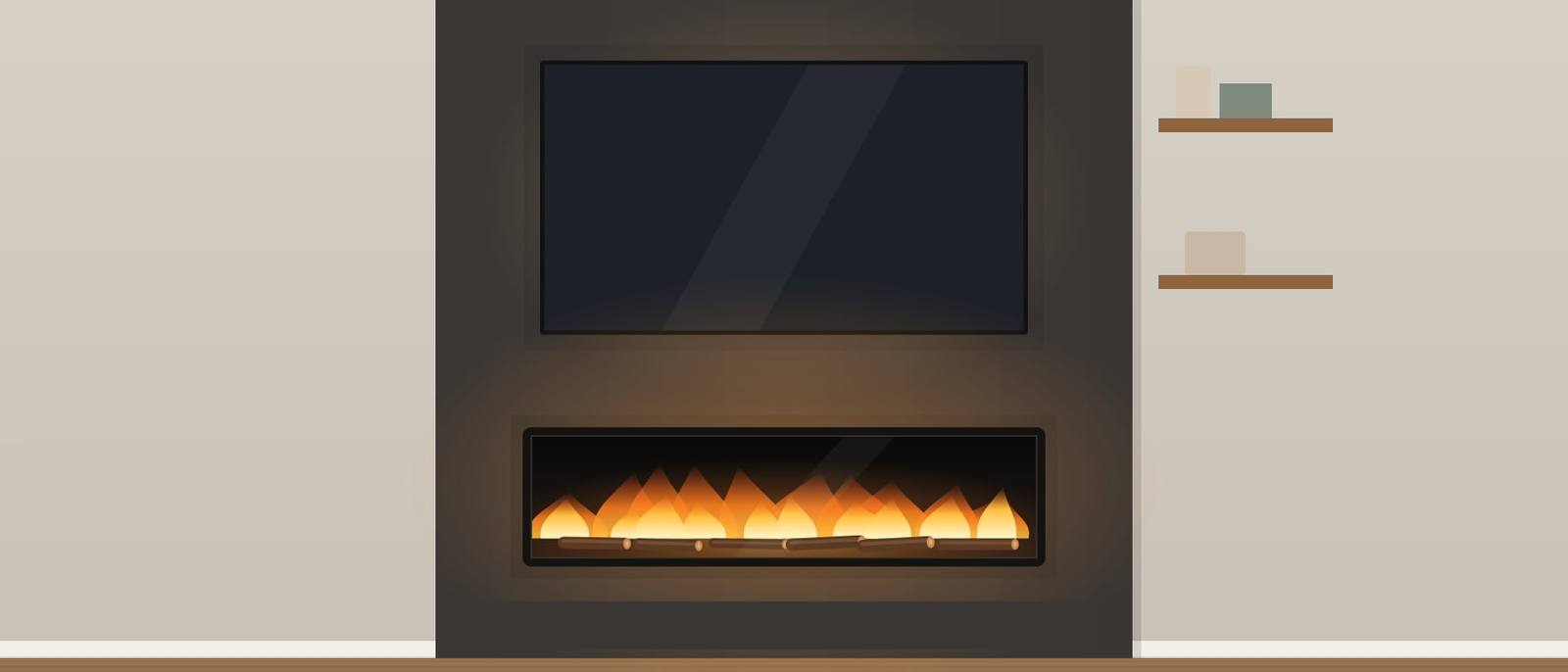
A media wall fire is an electric fire built into a false wall, usually under a TV, so that only the glass and a slim trim show. Get three things right and the rest is taste: a fire made to be recessed, a width that suits the TV and the wall, and a recess built to the fire's own installation figures. This guide goes through each one, then covers heat, power and a checklist for buying.
What counts as a media wall fire
A media wall is a timber or metal stud frame fixed to an existing wall and covered in plasterboard. It creates a flat, deeper surface with recesses for a TV, a fire and often shelves or lighting.
The fire in it is an inset fire: it slides into a box in the frame, and the front of the fire lines up with the finished wall. That is different from a wall mounted fire, which hangs on a bracket on the surface of a wall. Some fires are sold as suitable for both, but many are not. If a fire is designed to hang in open air, it may push heat out of the top or sides, and in a recess that heat has nowhere to go. Always buy a fire that the maker describes as suitable for recessing, and follow its manual.
Front facing or three sided?
Front facing fires have glass only at the front. The recess is a simple rectangle, so they are the easiest to build around and the most forgiving if your measurements are a few millimetres out.
Three sided fires have glass at the front and both ends. From the side of the room you still see the flames, and the fire looks deeper. They suit media walls that stand proud of the main wall, or designs where the fire sits at a corner of the build. The recess has to leave the end glass visible, so the build needs more care. Some three sided fires come with panels to cover the side glass if you change your mind; check before you buy if that matters to you.
There are also single sided fires for a corner, with glass on the front and one end. The same logic applies: the side with glass must not be buried in the wall.
Choosing the width
Media wall fires are sold in inch classes: 40, 50, 60 and 70 inch are common. The figure usually describes the overall width of the fire, but some makers quote the visible flame width instead, so check the dimensions in the specification.
TVs are measured differently: by the diagonal of the screen. That makes direct comparisons misleading. Here is the approximate width of a 16:9 screen next to the width of each fire class:
| TV size | Screen width (approx.) | Fire class | Fire width (approx.) |
|---|---|---|---|
| 50 inch | 111 cm | 40 inch | 102 cm |
| 55 inch | 122 cm | 50 inch | 127 cm |
| 65 inch | 144 cm | 60 inch | 152 cm |
| 75 inch | 166 cm | 70 inch | 178 cm |
TV casings add a little to these screen widths, so measure your own set.
There is no fixed rule, but two layouts tend to look right:
- Fire slightly narrower than the TV. Calm and balanced, and it leaves room for the media wall to frame both.
- Fire slightly wider than the TV. A stronger horizontal line, popular in larger rooms and with three sided fires.
What usually looks wrong is a fire much narrower than the TV, which looks lost, or one that runs almost to the edges of the media wall, which looks cramped. The simplest test is to mark the TV and fire outlines on the wall with masking tape and look at them from the sofa for a day.
Reading the recess dimensions
Every inset fire has installation drawings with a recess width, height and depth, and sometimes a gap needed around the fire for air. Those figures are what you build to. Do not build the opening to the outside size of the fire unless the manual tells you to.
A worked example, using made-up figures for illustration:
- The manual asks for a finished recess 1,280 mm wide, 460 mm high and 160 mm deep.
- You will line the inside of the recess with 12.5 mm plasterboard on the top, bottom and both sides.
- So the opening in the timber frame has to be 1,280 + 2 x 12.5 = 1,305 mm wide and 460 + 2 x 12.5 = 485 mm high.
- Depth is measured from the face of the finished wall to the back of the recess. If the back of the recess is boarded too, allow for that board as well.
Three habits avoid most mistakes:
- Choose the fire before you build the frame. Then draw the media wall around the fire, not the other way round.
- Measure the fire on arrival before the boards go up. Compare it with the manual.
- Keep the manual's ventilation gaps. Some fires need air to flow around or behind them.
Heat outlet and the TV above
Most media wall fires heat with a fan heater. Where the warm air comes out changes how you build the wall:
- Top outlet: warm air rises straight up the face of the wall, towards the TV. The manual will set a minimum gap between the fire and anything above it.
- Front or bottom outlet: air is pushed out into the room or down towards the floor, which keeps more heat away from the TV.
Follow the clearance in the fire's manual, and look at what your TV manufacturer says about heat sources below the screen. If the two disagree, use the larger gap. A shelf or mantel between fire and TV can help deflect warm air, but only if the fire's manual allows something to be fitted there.
How much heat to expect
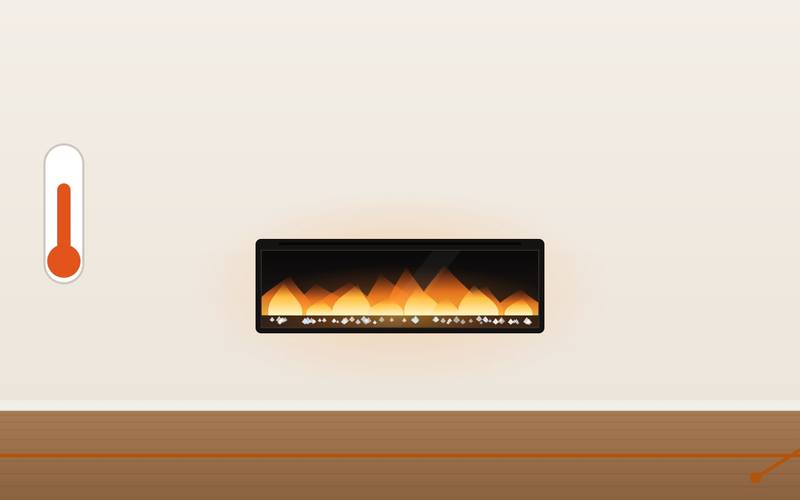
Most media wall fires give up to about 2 kW of heat, usually with a lower setting around 1 kW. A wider fire does not mean a hotter fire. In a large open-plan room a 2 kW fire adds warmth and atmosphere but will not replace your central heating. Our guide to heat output and room size shows how to check your room.
Almost all of them let you run the flames without heat, which costs very little. The running cost guide has the sums.
Flames and fuel beds
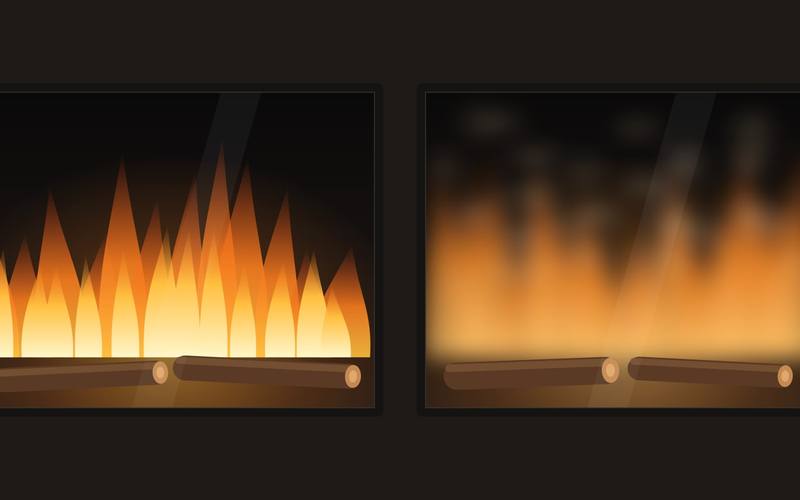
The flame effect is the part you look at every evening, so it is worth choosing with care. Most media wall fires use LED flames with a choice of fuel beds: logs for a traditional look, pebbles or crystals for a modern one. Many let you change flame colour and brightness. A few use water vapour for a softer, three dimensional effect. Our guide to flame effects compares them.
Power: plan it before the plasterboard
A media wall fire needs power inside or beside the wall. There are two common set-ups:
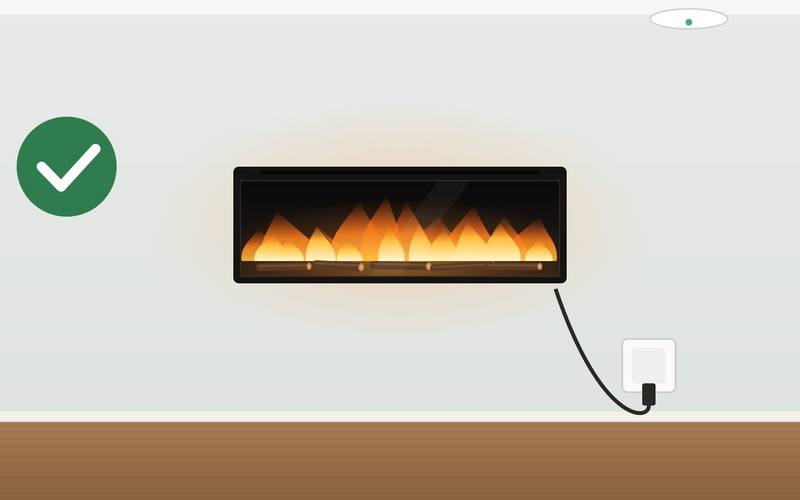
- Plug-in: the fire has a 13 A plug. You need a socket where you can reach it to unplug the fire, often in a cupboard or niche next to the fire, not sealed behind it.
- Hardwired: the fire is wired to a fused connection unit (a switched spur) beside the media wall, so you can isolate it with a switch.
In England, adding a socket or a fused spur to an existing circuit in a living room is not notifiable under Part P of the building regulations, but running a new circuit from the consumer unit is. Either way the work should meet the wiring regulations and be tested. Our guide to installing a media wall fire safely explains who can do what.
Plan the TV sockets and cable routes at the same time, and keep the fire on its own wall socket, not on an extension lead hidden in the wall.
Checklist before you buy
- Is the fire sold as suitable for recessing in a media wall?
- Front facing, three sided or corner: does the design of your wall leave the glass visible?
- Does the width suit your TV and the media wall, checked with masking tape on the wall?
- Do you have the recess width, height and depth from the manual, and room for any ventilation gap?
- Where does the heat come out, and what clearance does the manual ask for above the fire?
- Plug-in or hardwired, and where will the socket or fused spur go?
- What heat output does it have, and is it enough for the room?
- Which fuel beds and flame colours come with it?
If you can answer all eight, you are ready to choose. Our media wall fires section lists the types we are preparing, with the details we can already confirm.
Frequently asked questions
What size media wall fire do I need for a 65 inch TV?
A 65 inch TV screen is about 144 cm wide. A 50 inch fire (about 127 cm) sits slightly inside the TV width, which many people find balanced. A 60 inch fire (about 152 cm) is a little wider than the screen and gives a stronger, more linear look. Draw both options to scale on your wall before you decide.
How deep does a media wall need to be for a fire?
As deep as the recess depth in the fire's manual, plus the plasterboard and any space the manual asks for behind the fire. Slim media wall fires need much less depth than a chimney breast, but the figure varies by model, so choose the fire before you build the frame.
Can I put any electric fire in a media wall?
No. Use a fire that the manufacturer says can be recessed or inset, and follow its recess dimensions and ventilation advice. A wall mounted fire built to hang in open air may push heat out of the top or sides, where a recess would trap it.
Is it safe to put a TV above a media wall fire?
It is the usual layout, but check where the fire's heat comes out and the clearance its manual asks for above it, and read your TV maker's guidance on heat. Fires that send warm air forwards or downwards are easier to pair with a TV than ones with a top outlet.
Should the fire be plug-in or hardwired?
Either can work. A plug-in fire needs a socket that you can reach to switch off. A hardwired fire is connected to a fused connection unit, usually by an electrician. Plan the position before the plasterboard goes up.