Running costs
How much does an electric fire cost to run in the UK?
Electric fire running costs worked out: kW x unit rate, the Ofgem price cap for October to December 2026, cost per hour and per evening, and how to cut it.
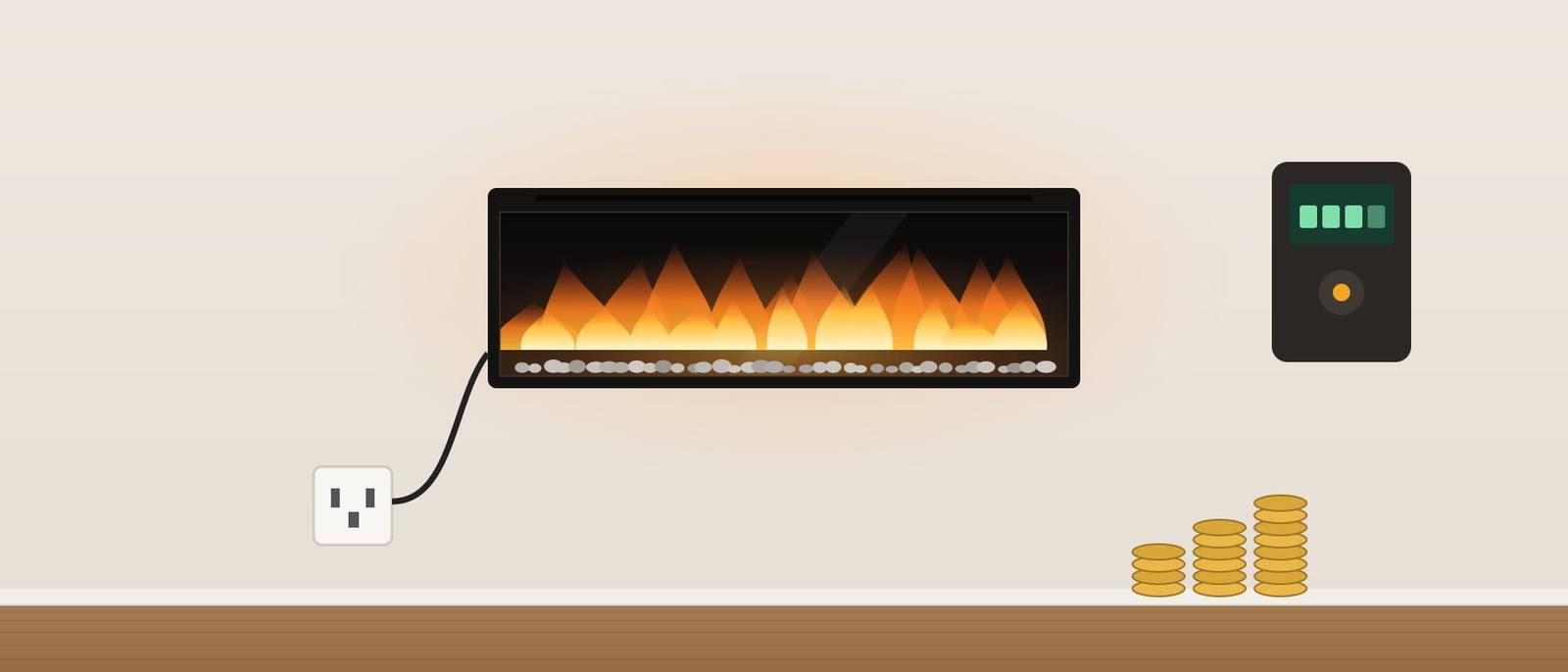
Short answer: an electric fire costs its power in kilowatts multiplied by the price of a kilowatt hour. Under the Ofgem price cap that applies from 1 October to 31 December 2026, the average electricity unit rate for Direct Debit customers is 26.32p per kWh. So a typical 2 kW fire on full heat costs about 53p an hour, on a 1 kW setting about 26p an hour, and with the flame effect alone usually less than a penny an hour.
The rest of this guide shows where those numbers come from, how to redo the sum with your own tariff, and what you can change to pay less.
The formula: kW x price per kWh
Two units cause most of the confusion, so it is worth getting them straight.
- kW (kilowatt) is power: how fast an appliance uses electricity. An electric fire's heater is usually rated at about 1 to 2 kW.
- kWh (kilowatt hour) is energy: what your meter counts and what you pay for. One kWh is 1 kW used for one hour.
That gives a simple formula:
Cost per hour = power in kW x unit rate in pence per kWh
A 2 kW heater running for one hour uses 2 kWh. At 26.32p per kWh that is 2 x 26.32 = 52.64p. A 1.5 kW setting uses 1.5 kWh an hour, which is 39.48p.
If your fire's power is given in watts, divide by 1,000 to get kW. A flame effect listed at 30 W is 0.03 kW.
The current price cap, checked
Ofgem, the energy regulator for Great Britain, sets a cap on the unit rate and standing charge that suppliers can charge on standard variable tariffs. It changes every three months. When we checked Ofgem's website on 14 November 2026, the cap for 1 October to 31 December 2026 was:
| Electricity, Direct Debit, average | Price cap level |
|---|---|
| Unit rate | 26.32p per kWh |
| Standing charge | 54.83p per day |
Ofgem notes that there is no VAT on electricity from 1 October 2026 to 31 March 2027, so the 26.32p figure has no VAT on top. For comparison, the average gas unit rate in the same period is 7.97p per kWh including 5% VAT.
Three things to keep in mind:
- These are averages. Rates differ by region and by how you pay. Ofgem publishes regional tables, and your bill or app shows your own unit rate. The cap covers England, Scotland and Wales; Northern Ireland has its own regulator.
- Fixed tariffs are different. If you are on a fixed deal, use the unit rate in your contract, not the cap.
- The cap moves. A new cap starts on 1 January 2027. Rerun the sum with the new rate when it is published.
Running costs at a glance
All figures below use 26.32p per kWh and assume the heater runs at that power the whole time. The flame-only row uses an example figure of 30 W; check the specification of your fire for its real number.
| Setting | Power | Per hour | 3-hour evening | 3 hours a day for a week |
|---|---|---|---|---|
| Flame effect only (example) | 0.03 kW | 0.8p | 2.4p | 17p |
| Low heat | 1 kW | 26.3p | 79p | £5.53 |
| Medium (some fires) | 1.5 kW | 39.5p | £1.18 | £8.29 |
| High heat | 2 kW | 52.6p | £1.58 | £11.05 |
These are upper limits for each setting. In real use the thermostat switches the heater off once the room reaches the temperature you set, and back on when it cools. How much of the time it runs depends on the room, the weather, your insulation and the setting, so nobody can give you an exact figure without measuring.
A worked example for one winter. Say you use the fire for three hours every evening from the start of November to the end of February, about 120 evenings, and the heater averages 1 kW over that time because the thermostat cycles it. That is 3 x 1 x 120 = 360 kWh. At 26.32p per kWh it comes to about £95 for the winter. The figure changes as the price cap changes, and your own use may be higher or lower.
Flame effect only: the cheap part
Most electric fires let you run the flames without the heater. Modern flame effects use LEDs, which need very little power compared with a heating element. That makes the flame effect a cheap way to enjoy the look on mild evenings in autumn and spring.
Fires that create flames from water vapour use a little more power than LED-only fires, because they also run the parts that turn water into mist and a small fan to lift it. Even so, it is still far below the heater's draw. Our guide to flame effects explains the different systems.
To find the real number, look in the specification or manual for "power in flame only mode", "standby" or similar. Multiply it by your unit rate in the same way.
Electric fire vs gas central heating
Every kWh of electricity a heater uses turns into a kWh of heat in your room. Nothing is lost up a chimney. In that sense an electric fire is 100% efficient at the point of use.
The catch is price. Under the current cap a kWh of electricity costs 26.32p and a kWh of gas costs 7.97p, so electricity is about 3.3 times as expensive per kWh. A gas boiler turns most, but not all, of its gas into heat, yet it still usually delivers heat more cheaply than a plug-in heater.
Where an electric fire can save money is in how you heat. If you spend the evening in one room, heating just that room with the fire while you turn the radiator thermostats down elsewhere can cost less than heating the whole house. If you run the fire as well as full central heating, it only adds to your bill.
How to pay less
- Use the thermostat. Set it to the temperature you want rather than leaving the heater on full. A degree or two lower makes a noticeable difference over a winter.
- Use the timer. Many fires have a timer so the heater comes on before you sit down and goes off when you leave the room. It also means you do not leave it running by accident.
- Start on low. In a small or well insulated room, the 1 kW setting may be enough once the room is warm.
- Flames only on mild evenings. You get the look for pennies.
- Keep the heat in. Close the door to the room, draw the curtains after dark and deal with obvious draughts around windows and doors.
- Check your tariff. If you are on a time-of-use tariff, remember that most people use a fire in the evening, which is often the more expensive time.
- Watch your in-home display. If you have a smart meter, switch the heater on and off and watch the reading change. It is the quickest way to see what your fire really uses.
What to look for when you buy
If running cost matters to you, compare these points in the specification:
- Heat settings. Two settings, often about 1 kW and 2 kW, give you a cheaper option for milder days.
- Thermostat. An electronic room thermostat holds the temperature more closely than a simple on and off switch.
- Timer. A weekly or daily timer stops the heater running when nobody is in the room.
- Flame only mode and its power draw. The lower, the better if you use the flames a lot.
- The right output for the room. A fire that is too small for the room will run flat out all evening. Our guide to heat output and room size shows how to check.
Doing the sum for your own fire
- Find the heater's power on the label or in the specification, in kW. If it is in watts, divide by 1,000.
- Find your unit rate on your bill or in your supplier's app, in pence per kWh.
- Multiply the two. That is your cost per hour on that setting.
- Multiply by the hours you expect to use it.
For example, with a 1.8 kW fire and a unit rate of 24p per kWh: 1.8 x 24 = 43.2p an hour, or about £1.30 for a three-hour evening at full power.
The numbers are simple once you have the two figures, and they let you compare fires on running cost before you buy. If you are still choosing a fire, our wall mounted electric fires and electric stoves list the heat settings of each type we are preparing.
Frequently asked questions
How much does a 2 kW electric fire cost per hour?
Multiply 2 kW by your unit rate. At the average Ofgem price cap unit rate for Direct Debit customers from 1 October to 31 December 2026, 26.32p per kWh, a 2 kW fire on full heat costs about 53p an hour. On a 1 kW setting it is about 26p an hour.
How much electricity does the flame effect use?
Much less than the heater. LED flame effects usually draw a small fraction of a kilowatt; the exact figure is in the specification, often listed as power in flame only mode. As an example, a flame effect that draws 30 W costs under 1p an hour at 26.32p per kWh.
Is an electric fire cheaper to run than central heating?
Per unit of heat, no. Under the current price cap a kWh of electricity costs about 3.3 times as much as a kWh of gas. An electric fire can still save money if it lets you heat only the room you are in and turn the central heating down elsewhere.
Are electric fires 100% efficient?
At the point of use, yes: all the electricity a heater uses ends up as heat in the room, and nothing goes up a flue. That does not make it cheap, because electricity costs more per kWh than gas.
Does the standing charge go up if I use an electric fire?
No. The standing charge is a fixed daily amount you pay whatever you use. Only the unit rate part of your bill grows when you run the fire.