Installation
Installing a media wall fire safely: plug-in, hardwired, Part P
How to install a media wall fire safely: plug-in or hardwired, where the socket goes, when you need an electrician under Part P in England, building the recess.
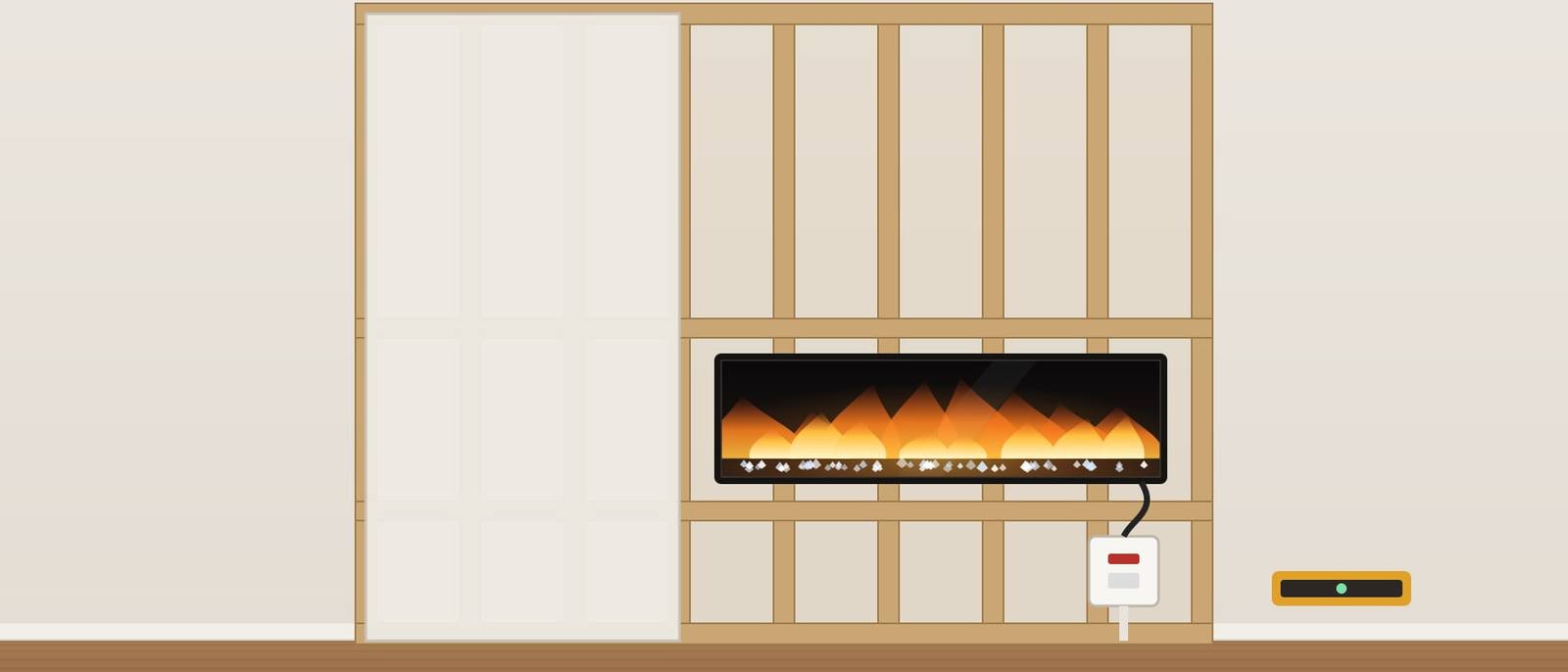
A media wall fire can be fitted safely by a careful DIYer as long as the electrical side is right. Plugging a fire into an existing socket needs no electrician. Adding a socket or a fused spur to an existing circuit in a living room is allowed in England without notifying building control, but it still has to meet the wiring regulations and be tested. A new circuit is notifiable building work under Part P and must be done by a registered competent person or notified to building control.
This guide covers the building rules for England, the choice between plug-in and hardwired, where to put the socket, and how to build the recess.
The rules: Part P in England
Electrical work in homes in England falls under Part P of the Building Regulations. The government's guidance on it is Approved Document P (2013 edition). It splits work into notifiable and non-notifiable.
Notifiable work is listed in regulation 12(6A):
- the installation of a new circuit;
- the replacement of a consumer unit;
- any addition or alteration to existing circuits in a special location.
A special location means the space around a bath or shower (up to 2.25 m above the floor and 0.6 m from the edge of the bath or shower tray, or 1.2 m from a shower head with no tray), and any room containing a swimming pool or sauna heater.
Everything else is non-notifiable, for example adding a socket or a fused connection unit to an existing circuit in a living room. Approved Document P is clear that non-notifiable work still has to be designed, installed, inspected and tested to BS 7671, the wiring regulations, and that local authorities can act if they find unsafe work.
Approved Document P also says that installing fixed electrical equipment is within the scope of Part P even when the final connection is a standard 13 A plug, but that it is only notifiable if it involves one of the three types of work above.
Who can do notifiable work
For notifiable work you can use:
- an electrician registered with a competent person scheme, who self-certifies the work and arranges the building regulations certificate; or
- a registered third-party certifier; or
- a building control body, by notifying the work before it starts.
The simplest route is the first one. Ask for the electrical installation certificate or minor works certificate for your records.
Wales, Scotland and Northern Ireland
Wales uses its own edition of Approved Document P, and the list of notifiable work is not the same as in England. Scotland and Northern Ireland have their own building regulations. If you live outside England, ask your local building control or a registered electrician before you plan any wiring.
Plug-in or hardwired?
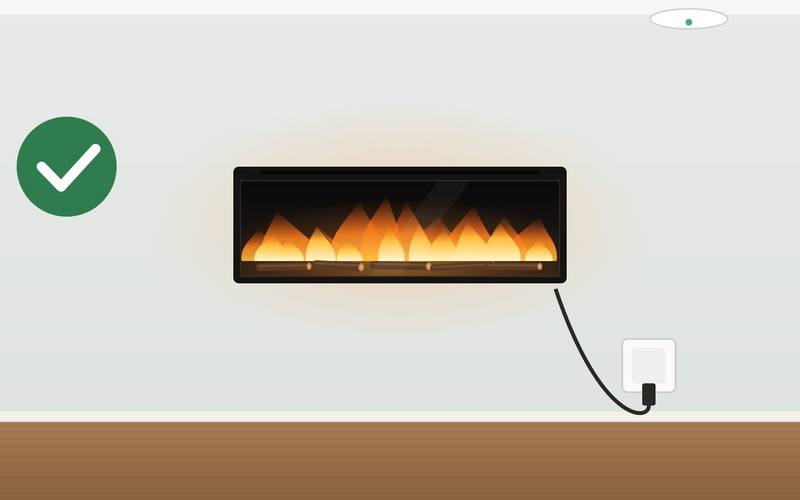
Plug-in fires come with a 13 A plug. They need a socket that you can reach to unplug the fire. This is the simplest set-up, and many media wall fires are sold this way.
Hardwired fires are connected to a fused connection unit, often called a switched spur: a wall plate with a fuse and a switch. The switch lets you isolate the fire without opening the wall. Some fires are designed to be wired this way; the manual will say.
Whichever you choose:
- Keep the means of isolation accessible. You must be able to switch the fire off or unplug it without taking the fire out of the wall.
- Do not hide a socket where the manual says it must not go, such as directly behind a fire that gets hot at the back.
- Do not use an extension lead or multi-way adapter inside the wall. Electrical Safety First advises against powering heaters from extension leads, as they can be overloaded.
- Give the fire its own socket or spur, separate from the TV and other equipment.
Planning the power before you build
Most problems start because the wall is boarded before the power is planned. Decide these points while the frame is still open:
- Where the socket or spur goes. Common spots are a niche or cupboard beside the fire, the side of the media wall, or a switched spur on the main wall next to it.
- How the cable gets there. In a stud wall, cables run inside the frame. Electricians follow set safe zones for hidden cables so that people can tell where not to drill later, and use protection where the rules require it.
- Where the TV and other sockets go, and keep them separate from the fire's supply.
- Whether you need a new circuit. If the existing circuit is already heavily loaded, or there is no circuit nearby, your electrician may suggest a new one. In England that is notifiable.
If someone other than you does the wiring, agree the positions with them on the bare frame, then take photos of the cable routes before the boards go on.
Building the recess
The fire's manual is your rulebook. It will give:
- the recess width, height and depth;
- any gap or ventilation needed around or behind the fire;
- whether parts of the recess must be lined with non-combustible material;
- how the fire is fixed in the recess, for example brackets screwed to the frame;
- the clearance above the fire to a TV, shelf or mantel.
Build the frame so that the finished recess matches those figures, remembering that plasterboard on the inside faces makes the opening smaller. A worked example is in our media wall fire buying guide.
A few practical points:
- Frame strength. Add timber noggins where the fire's brackets and the TV bracket will fix.
- Level and square. A fire with a long glass front shows every millimetre of a crooked recess.
- Access. Make sure the fire can be slid out again for servicing without breaking the wall.
- Test fit early. Dry fit the fire in the frame before boarding, then again before plastering.
- Dust. Keep the fire boxed until sanding and decorating are finished. Dust in the heater can smell when it first warms up.
The TV above the fire
Most media walls put the TV above the fire. Read two documents before you set the gap: the fire's manual, for the minimum clearance above it, and your TV maker's guidance on heat sources. Fires that send heat forwards or downwards are easier to combine with a TV than fires with a top outlet. If the two documents give different figures, use the larger one.
After installation
- Check the fire works on all settings, flames only and both heat settings, before you finish decorating around it.
- Keep the paperwork: the fire's manual, any electrical certificate, and the building regulations certificate if the work was notifiable.
- Register the fire with the manufacturer if they offer it, so they can contact you about safety recalls. Electrical Safety First recommends registering heaters for this reason.
- Fit or test smoke alarms. Electrical Safety First suggests at least one smoke or heat alarm on every floor, tested monthly.
Quick checklist
- Fire sold as suitable for recessing in a media wall.
- Recess built to the manual's finished dimensions and gaps.
- Socket or spur accessible, and not where the manual forbids it.
- No extension lead or adapter.
- New circuit? Use a registered electrician or notify building control (England).
- Clearance to the TV checked against both manuals.
- Fire tested before decorating; certificates and manual kept.
For general safety in use, read are electric fires safe?. To choose the fire itself, see our media wall and inset fires.
Frequently asked questions
Do I need an electrician to install a media wall fire?
Not to plug a fire into an existing socket. You need someone competent for any new wiring: a new socket or fused spur inside or beside the media wall, or a new circuit. In England a new circuit is notifiable under Part P, so it must be done by a registered competent person or notified to building control.
Is adding a socket for a media wall fire notifiable under Part P?
In England, adding a socket or fused connection unit to an existing circuit is not notifiable if it is outside a special location such as the area around a bath or shower. It must still meet the wiring regulations, BS 7671, and should be inspected and tested.
Can the socket go behind the fire?
Only if the fire's manual allows it. You must be able to switch off and unplug the fire, so most installers put a socket in a nearby niche or cupboard, or wire the fire to a switched fused spur beside the wall.
Do the Part P rules apply in Wales and Scotland?
Wales uses its own edition of Approved Document P, and the list of notifiable work differs from England. Scotland and Northern Ireland have their own building regulations. Ask your local building control or a registered electrician.
Can I plug a media wall fire into an extension lead?
No. Electrical Safety First advises against powering heaters from extension leads because they can be overloaded. Give the fire its own wall socket or a fused spur.