Sizing
What size electric fire do I need? Heat output and room size
How much heat an electric fire gives, the room volume divided by 14 rule, a table of room sizes, and what to do when your room needs more than 2 kW.
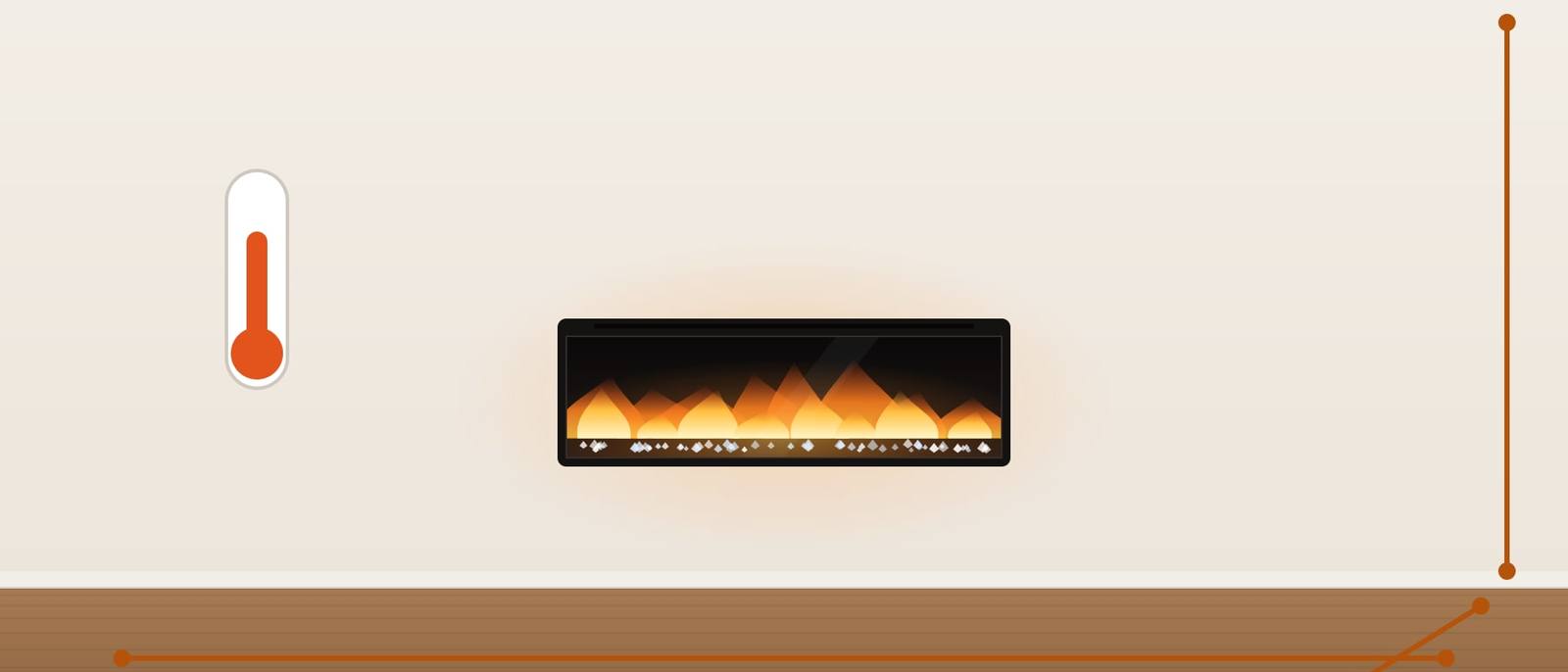
Most plug-in electric fires give up to about 2 kW of heat, usually with a lower setting around 1 kW. To see whether that is enough, work out your room's volume in cubic metres and divide by 14. If the answer is 2 or less, a 2 kW fire can heat the room on its own on a cold day. If it is more, the fire will still help, but treat it as extra heat on top of your central heating rather than the main source.
The sections below explain the rule, give a table for common room sizes, and cover the other things that decide how warm a room feels.
Heat output in plain terms
An electric fire's heat output is its power in kilowatts (kW). A heater rated at 2 kW turns 2 kW of electricity into 2 kW of heat. There is no flue and no combustion, so nothing is lost up a chimney.
Most fires have two heat settings, often about 1 kW and 2 kW, plus a flame-only mode with no heat. Some smaller fires and stoves have a lower maximum, and some fires that are wired in rather than plugged in can give more, but plug-in models of about 2 kW are the most common.
Width is not heat. A 60 inch wall mounted fire and a 40 inch one often have the same 2 kW heater. Choose the width for how it looks on the wall and check the kW figure for warmth.
The room volume divided by 14 rule
The most widely used rule of thumb in the UK stove and fireplace trade goes like this:
- Measure the room's length, width and height in metres.
- Multiply them to get the volume in cubic metres.
- Divide by 14 to get a rough heat requirement in kW.
For a living room 4 m long, 4 m wide and 2.4 m high: 4 x 4 x 2.4 = 38.4 cubic metres. Divided by 14, that is about 2.7 kW.
Retailers usually describe the rule as enough heat to bring a room with average insulation to a comfortable temperature on a cold winter day. It is a starting point, not a calculation of your home's heat loss. Some stove retailers adjust the divisor for insulation:
- Poorly insulated (solid walls, single glazing, draughts): divide by about 10.
- Average: divide by 14.
- Very well insulated new build: divide by up to 25.
For the same 4 x 4 x 2.4 m room, that gives roughly 3.8 kW for a draughty room and about 1.5 kW for a very well insulated one.
Table: common room sizes
All rooms below have a 2.4 m ceiling unless stated. Figures use the divide by 14 rule and are rounded.
| Room | Volume | Heat needed (approx.) | Can a 2 kW fire do it alone? |
|---|---|---|---|
| 3 x 3 m bedroom or snug | 21.6 m³ | 1.5 kW | Yes |
| 4 x 3 m small living room | 28.8 m³ | 2.1 kW | About right |
| 4 x 4 m living room | 38.4 m³ | 2.7 kW | Top-up only |
| 5 x 4 m living room | 48 m³ | 3.4 kW | Top-up only |
| 6 x 4 m through lounge | 57.6 m³ | 4.1 kW | Top-up only |
| 7 x 5 m open plan, 2.5 m ceiling | 87.5 m³ | 6.3 kW | Top-up only |
"Top-up only" does not mean the fire is useless in that room. On a mild day, or with the radiators on low, a 2 kW fire can make a big room feel comfortable around the sofa. It just will not hold the whole room at a comfortable temperature by itself on the coldest days.
What the answer means for your choice
If your room needs 2 kW or less, any plug-in fire with a 2 kW setting should cope. The thermostat will switch it to low or off once the room is warm, which keeps running costs down.
If your room needs a little more than 2 kW, a 2 kW fire will run on full for longer and may struggle on very cold days. Keep the central heating on low and let the fire do the rest. Draught proofing helps more than you might expect.
If your room needs much more, for example a large open-plan space, choose the fire for its looks and atmosphere and keep your main heating as the source of warmth. Two fires on separate wall sockets is another option, but compare the running cost with heating the room some other way. Our running cost guide shows how to work it out.
How the heat reaches you
Most wall mounted, media wall and inset electric fires heat with a fan heater. A small element warms air and a fan pushes it into the room. Fan heat warms the air quickly, but it needs to circulate, so the room layout matters:
- Keep the outlet clear. A sofa, curtain or rug in front of it blocks the airflow and is a safety risk. Electrical Safety First suggests keeping heaters at least one metre from combustible materials.
- Mind the direction. Fires with a top outlet send warm air up the wall; front and bottom outlets push it into the room. In a media wall under a TV, front or bottom outlets are often the better choice.
- Expect some fan noise. It is usually quiet, but if you are sensitive to it, look for the noise level in the specification or listen to the fire before you buy.
Controls matter as much as kW
A fire that matches your room still wastes money if it runs flat out all evening. Look for:
- An electronic room thermostat that holds a set temperature.
- A timer, ideally one that can be set for different days, so the heater runs only when you are in the room.
- Separate flame and heat controls, so you can have the flames on their own.
These controls are not only convenient. Since 1 January 2018, ecodesign rules for local space heaters have set minimum seasonal efficiency figures for fixed electric heaters, 38% for those above 250 W, and the way that figure is calculated rewards controls such as electronic thermostats and timers. The rules come from Regulation (EU) 2015/1188, which is still published on legislation.gov.uk as law in Great Britain.
Special cases
Open-plan rooms. Measure only the area the fire will realistically heat, not the whole ground floor. Heat from a single fire drifts towards the nearest open stairs and doors.
Conservatories and extensions. Large areas of glass lose heat quickly, so use the lower divisor for a poorly insulated room.
Bedrooms. Small rooms need little heat, and the lower setting is often enough. Electrical Safety First advises not to leave a heater running while you are asleep, so use the timer to switch the heater off before bedtime.
Rooms with an open chimney. An open flue pulls warm air out of the room. If you put an electric fire or stove in an old fireplace, ask a chimney sweep or builder about capping the chimney with suitable ventilation.
Quick method
- Multiply length x width x height of the room in metres.
- Divide by 14 (or by 10 for a draughty room, up to 25 for a very well insulated one).
- Compare the answer with the fire's maximum kW.
- If the fire is smaller than the answer, plan on using it alongside your other heating.
- Check that the fire has a thermostat, a timer and a flame-only mode.
Ready to compare? Our wall mounted electric fires, media wall fires and electric stoves list the heat settings of each type we are preparing.
Frequently asked questions
Is a 2 kW electric fire enough for a living room?
It depends on the size and insulation of the room. Using the common rule of room volume divided by 14, 2 kW suits a room of up to about 28 cubic metres, for example 4 x 3 m with a 2.4 m ceiling. In larger rooms a 2 kW fire works well as extra heat alongside central heating.
Do wider electric fires give more heat?
Not usually. Most plug-in electric fires top out at about 2 kW whether they are 40 or 70 inches wide. The width is about looks; compare the kW figure for heat.
What does the divide by 14 rule assume?
It is a rule of thumb from the UK stove trade, usually described as enough heat to bring a room of average insulation to a comfortable temperature on a cold day. Some retailers divide by about 10 for a poorly insulated room and by up to 25 for a very well insulated new build.
Can I run two electric fires in the same room?
Yes, as long as each has its own wall socket and your wiring is in good condition. Do not run both from one extension lead or adapter. If you are unsure what a circuit can take, ask an electrician.
Should I choose a fire with a thermostat?
Yes. A thermostat switches the heater off when the room reaches the temperature you set, so it does not run flat out all evening. Combined with a timer, it is the simplest way to keep running costs down.